Antipodean59's Blog

Restored New Testament Christianity

Archive for the category “Christianity”

Be careful you do not skew the Bible message by your ommission

An excellent article regarding fundamental Bible understanding where the author says “One must take the “sum” of truth on a

particular item (Psalm 119:160) — not “some” of the truth.”

Go to the article and build your faith.

Graham

The Dangers of the ‘Gaia’ Movement

In my research regarding the origin of life it was inevitable that I should tackle organic evolution. The problem with the organic evolution hypothesis is the beginning of all things. The proponents claim there was once nothing then came something but the crux of the problem then becomes how you get something from nothing. Mathematically it is not possible despite the intellectual gymnastics of quantum fluctuations – Whatever! David Darling said it well, “You cannot fudge this by appealing to quantum mechanics. Either there is nothing to begin with, in which case there is no quantum vacuum, no pre-geometric dust, no time in which anything can happen, no physical laws that can effect change from nothingness into somethingness; or there is something, in which case that needs explaining” [On Creating Something From Nothing, New Scientist, vol.151 (Sept 14 1996)].

The graveyard of scientific theories regarding origins is littered with peer reviewed failures that includes the Big Bang and as Sir Fred Hoyle once said “When a pattern of facts becomes set against a theory, experience shows that the theory rarely recovers” [The Big Bang Under Attack, Science Digest, vol 92 (May 1984), p.84].

Of course the proponents of evolution do not limit themselves to origins but also like to meddle in life on Earth. This is readily apparent in today’s world with the topic of discussion being Climate Change, the buzz term for human induced global warming aka Anthropogenic Global Warming (AGW). Most scientists that believe in this hogwash are agnostic at best or simply atheistic. Some have even invented a new religion closely resembling a New Age concept that arose from the dope-smoking, LSD days of the 1960s. Many of them are now in the halls of power around the world and are involved in complex social systems such as environmentalism, multi-culturalism, world federalism, etc. They can be linked to psychological cults such as mental health, self-awareness groups or pseudo-science such as anthropic principles, Gaia hypothesis etc. Many prominent personalities are involved in quasi-religious sects such as Christian Science, etc. They all postulate evolutionism as their scientific rationale that is pantheistic much like the Greeks, Romans and Babylonians espoused mixed with a dose of Hinduism, Buddhism, Taoism, Baha’i, etc. It is important to note that all deny special creation such as the Bible speaks of and all oppose, some vehemently, Biblical Christianity.

With that in mind I was curious of this term ‘Gaia’ and wondered how this fitted into the AGW argument. After all, the term Gaia is supposedly Earth personified as some sort of goddess, you know, ‘Mother Earth’ where she regulates all including humanity within her bounds. It turns out this term was used by Sir James Lovelock, a 1960s throwback whose chemistry career lead him to invent Gaia in 1970. He is one of the original ‘tree-huggers’ that has inspired a political movement that has gone viral ever since. Tim Beardsley writes, “Indeed, Gaia has almost become the official ideology of ‘Green’ parties in Europe: it appeals naturally to scientifically innocent individuals who worry about the environment” [Gaia, Scientific American, vol 261 (Dec 1989), pp.35-36]. I would go so far as to say this type of thinking has infested otherwise sane intellectual people who are ramming their new religion down the throats of objectors without a single thought to the democratic process [cf Aunty BBC article].

Let me present a case in point from a personal perspective. Last year (2010) the Local Body Elections took place in New Zealand during which the group called Transitions Timaru played host to a meet the prospective counsellors’ night. I attended this meeting out of curiosity as it was advertised in the Timaru Herald. The meeting held at Timaru’s Aoraki Polytechnic Campus was attended by Bob Calkin (local man of science that defends climate change as being human induced). I couldn’t help but notice the group consisted mainly of 1960s type people and even made a note that they seemed to spout off a lot of tree-hugging nonsense in their little huddles. Even one of the prospective counsellors had been convinced by this rot (or was he just trying to get their vote, hmm, I wonder?). I could note by the tone of the rhetoric that this Transitions Timaru had organised themselves into a voting bloc in order to influence the local body elections. Well, wouldn’t you know it that is exactly what Gaia inventor James Lovelock proposed in this blurb.

To call environmentalism a cult is an understatement. Many scientists, politicians, and hangers on, as you will see, actively and vocally espouse the tenets of ‘Gaia’. The dangers of such a cult following become apparent when you read of the leading, well recognised advocates’ inner thoughts. ‘Gaia’ is anti-God, anti-Bible and ultimately anti humanity, for its extremes’ advocate a human culling in order to bring equilibrium into the world’s environment. Gaia’s are deeply committed to ‘protecting the earth from humanity’ also known as ‘Deep Ecology’.

Now to some of those well recognised and incredibly influential names that believe in this form of holocaust.

• Dr. Robert Muller. Founder of United Nations University of Peace. He worships Mother Earth and calls her ‘divine Earth’.
• Maurice Strong (Baha’i faith). Once a senior adviser to Kofi Annan (ex UN President whose son was involved in food for oil scam in the 1990s). He developed UN Environment Programme and makes the bold claim that humanity will be extinct in thirty years.
• Sir James Lovelock, the inventor of Gaia. His quote of note is, “By the end of this century the human population will be reduced to a few breeding pairs subsisting near the North Pole.”
• Al Gore (if they have a clergy in Gaia religion then Al would be High Priest). Gore’s claim to fame is his spoilt brat spat at losing the 2002 Presidency of USA to George W. Bush and his now widely acknowledged error riddled film indoctrinating the school children of the world regarding human induced climate change called An Inconvenient Truth. He has also setup Alliance for Climate Protection announcing the need for an ‘army of ten million climate activists.’ He claims the ancients worshipped ‘organised goddess worship’ which was eliminated by Christians in the late 15th century. He wants humanity to get back to this ancient form of worship because ‘armed with such faith, we might find it possible to resanctify the Earth’ (Earth in Balance). Al is not one to let a chance go by for he set up the Chicago Climate Exchange as a hedge-fund for carbon trading (now you see why governments in Europe and tin pot New Zealand adamantly want ETS laws – clever, uhh?).
• Mikhail Gorbachev. Former President of Soviet Union who was instrumental for the abandonment of communist Russia or at least that is what they want it to appear as (have you noticed ex KGB chief Putin is still controlling the strings over there, wink, wink, nod, nod). Gorbachev rubs shoulders with New Age nuts like Shirley Maclaine (Out On A Limb), Dennis Weaver (1960s TV series Gun Smoke), Ted Turner (CNN founder), Jane Fonda (‘Hanoi Jane’ i.e. Vietcong communist sympathiser) and many more. He also has strong ties with Maurice Strong, hence the UN implications.
• Prince Philip, Duke of Edinburgh. A ‘Deep Ecology’ fan, for he said ‘in the event that I am reincarnated, I would like to return as a deadly virus, in order to contribute something to solve over population’ (from his book If I Were an Animal). He is now 90 as I write this so if he gets his wish the ‘deadly virus’ may come sooner than you think for this nut to have his way.
• Steven Schneider is the lead author of many IPCC reports and editor of Scientists on Gaia. He says ‘the Gaia Hypothesis has now become established in mainstream science’. (This is your clue as to why the world’s lame stream media are reporting constantly that the ‘science is settled’ regarding AGW).
• Sir Richard Branson opportunist entrepreneur who launched the Virgin brand. Fabulously wealthy and intellectually brilliant until he met Al Gore, then he came out with this little gem, ‘my views on global warming were changed 180 degrees’. He then launched his Climate Challenge with the prize of $25 million to anyone who can remove CO2 from the atmosphere. The judges for this auspicious completion are Gore, Lovelock and James Hanson (NASA) among others. (Now I said intellectually brilliant to describe Branson but I guess I have to take this back because as any Gaia follower must know CO2 is vital for plants to grow and for humans to expel and I guess that doesn’t inspire much confidence in the judges’ intellect, either).
• Dr Tim Flannery ardent Australian environmentalist/activist/alarmist who has blown a lot of hot CO2 recently regarding the Aussies lack of ETS commitment (maybe we don’t give the Aussie mind-set enough credit regarding this issue – good on ya, mate!)
• Ted Turner, CNN founder who conceived ‘Captain Planet’ the USA children’s enviro propaganda machine and one-time husband to ‘Hanoi Jane’.

If you are still doubtful or now you are even more curious about the political macerations of the Gaia cult, then click on www.green-agenda.com and be further enlightened.

Graham

So, you think you know what faith is, uh?

Check out what my friend Dub McClish says about Biblical Faith

Importance of Pentecost

The day of Pentecost as referenced in Acts 2 was a result of fifty days from the Passover Sabbath (πεντηκοστή pentēkostē fiftieth from Passover, Strong’s Dict.). This day was counted from “the morrow of the Sabbath” (Lev.23:15) when the omer of barley harvest i.e. “wave sheaf” was first cut.  The count of these weeks was to start the day the sickle cut that first wave offering (Dt.16:9). This barley harvest was to be over and done within 7 weeks i.e. 49 days from which the “Feast of Ingathering” (Ex.23:16) or “Day of First Fruits” (Num.28:26) as they were known under the Old Testament could begin. This day of Pentecost marked the beginning of the wheat harvest, hence the term “first fruits”.  It is no coincidence, in my humble opinion, that the two different corns represent the Old (i.e., barley) and the New Testaments (i.e., wheat) [any crop farmer will attest barley always precedes wheat in harvest times].


A simple count of 49 days beginning “the morrow of the Sabbath” will, without exception, bring one to the first day of the week that we call Sunday.  This day marked the beginning of the church, of which there is, without exception, only one (Eph.4:4).


It goes without saying this church needed entry conditions explained i.e. the plan of salvation given by Peter upon request of those who crucified Jesus (Acts 2:37—41).  In addition, this church was instructed via the “apostle’s doctrine” regarding fellowship and worship (Acts 2:42-47). It is important to note that the “breaking of bread” in verse 42 differs from “breaking bread from house to house” found in verse 46. The former concerns the immediate context with the Lord’s Supper memorial for “the breaking” is tn klasis i.e. the fracture, the specific act of breaking the specific bread [the Greek places the definite article tn before breaking and tov before bread indicating specificity] that Adam Clarke points out: “Breaking of bread was that act which preceded a feast or meal, and which was performed by the master of the house, when he pronounced the blessing – what we would call grace before meat”. The word is employed by Matthew in chapter 26:26 where Jesus, the Master, “took the bread, blessed it and broke [klasis] it” because it represented His body upon the soon to be realised cross, a solemn and shameful (Gal.3:13) event.  This in contrast with the latter “break” is klaō i.e. to generically break which the immediate context of the remainder of the verse says “they ate their food with gladness and simplicity of heart”. They were simply breaking the food apart to eat it with gladness of fellowship together with people of common salvation.


This having been said indicates the absolute importance of the first day of the week for the church to assemble for authorised worship and fellowship.

Graham

Are We Added or Do We Join?

Many people are confused about the question of whether or not one joins the church which the Christ built or is added to it. Some rather casually say that they have decided to join the church of Christ. However, is that statement one that can be made accurately in light of what the Bible says about this subject? To find the answers, consultation of the Scriptures will be necessary. Acts chapter two describes the inception of the church. At the end of the chapter, Luke records this, “Praising God, and having favour with all the people. And the Lord added to the church daily such as should be saved” (Acts 2:47). An examination of this verse in the Greek text reveals that “the Lord” is the subject of this sentence. As the subject of this sentence, the Lord is doing the action, which is the Greek word translated “added.” Hence, God is performing the action of adding. Webster’s dictionary from 1828 gives these definitions for “add”: “…1. To set or put together, join or unite, as one thing or sum to another, in an aggregate; as, add three to four, the sum is seven. 2. To unite in idea or consideration; to subjoin… 3. To increase number… 4. To augment…” (E-sword, 2007). Those who were “added” were united or brought into the church by God. The next point that should be understood is the object of the “adding.” The Greek participle and its article “tous (article) sozomenous (participle)” is translated “such as should be saved” which we would understand as “the being saved ones.” This Greek word and its article are in the accusative case meaning that it is the direct object of the verb. “The being saved ones” were being added.

Who then are these saved ones? Our Lord clarified this in Mark chapter sixteen, “And he said unto them, Go ye into all the world, and preach the gospel to every creature. He that believeth and is baptized shall be saved; but he that believeth not shall be damned” (Mark 16:15-16). Jesus plainly stated that the saved are comprised of those that believe and obey the Gospel. Now please consider Acts 2:38-41. Those that were baptized (remember Mark 16:16) were those that had hearkened unto Peter’s sermon. Peter preached the Gospel, (again, please remember Mark 16:16) they believed, and were baptized; thus, becoming part of the saved. And it is the saved that were “added” by the Lord. There is an indirect object in this sentence, as well. The Greek noun and its article “ta (article) ekklasia (noun)” are in the dative case meaning that they are indirect objects. “The church” is the body into which the saved were added. The verb “added” was done to the saved and the saved were placed into the church. All of this was done by God.

The above explanations are somewhat in depth, though certainly not exhaustive. The verse which has been examined is a very simple and straight forward pronouncement of the process in question. Daniel chapter two supports the fact that the Lord adds one to the church, not man.

“And in the days of these kings shall the God of heaven set up a kingdom, which shall never be destroyed: and the kingdom shall not be left to other people, but it shall break in pieces and consume all these kingdoms, and it shall stand for ever. Forasmuch as thou sawest that the stone was cut out of the mountain without hands, and that it brake in pieces the iron, the brass, the
clay, the silver, and the gold; the great God hath made known to the king what shall come to pass hereafter: and the dream is certain, and the interpretation thereof sure” (Dan. 2:44-45). This kingdom (which is the church) would not be established or founded by men.

Our Lord said that He would build (establish) His church (Matt: 16:18). The adding of souls to that church was certainly a part of its establishment. Jesus said He would build His church. He is saying by implication that He would be adding to His body. The Lord is head over the church (Col. 1:18); and as Head, He determines the way into His body.

Our Lord rules over His kingdom (Col. 1:13, 18). Headship of the church, salvation, forgiveness, reconciliation, and the giving of commandments to be obeyed belongs to the Christ. The church was prepared, established, and is kept by God and not by man. The church is not a man-made nor human ruled body, to which we may join ourselves at our own discretion and upon our own terms. Acts 2:47 states the matter very plainly: the Lord adds us to church upon our obedience to the Gospel.

John Rose
Naples, Florida

“Ladies and Gentlemen, it is time to wake up”

Geert Wilders recent speech in Rome at the Magna Carta Foundation should stir you into action or you will eventually face the sword of Allah.

Read that speech here


Time to end the atheist foolish rants that there is no God

The Law of Causation says: every effect must have an adequate cause. Only someone who refuses reality would say differently. Therefore, the universe is not eternal, for someone must have caused its beginning (NB: only intelligence is capable of cause). Which, in turn, means it must have come from someone, for only those who are mathematically challenged believe nothing plus nothing equals something or that science can or will eventually produce the data to prove matter can create itself. The Law of Conservation provides enough proof that no matter is being created today. Also the Law of Biogenesis proves life only comes from life unless of course you still believe in Dark Age science.

Now if this is not so, then put up or shut up.

Atheism: The ‘No God’ religion

Before you cross your Rubicon

To cross the Rubicon is a metaphor meaning to deliberately go beyond the point of no return.

An interesting article that may open your eyes can be read here

Think about the consequences before you leap!

Graham

Be prepared or you will suffer

Degrees of Punishment

“But I say unto you, It shall be more tolerable for Tyre and Sidon at the day of judgment, than for you.” (Matthew 11:22)

The subject of eternal hell is so repugnant to the modern ungodly world that people desperately search for some scientific rationale to justify their rejection of God’s Word. Charles Darwin was an example. He became an apostate from Christianity, not because of his scientific “discovery” of natural selection, but because of Christ’s teachings that unbelievers (including his own father) would end up in hell.

Nevertheless “the fearful, and unbelieving . . . and idolaters, and all liars, shall have their part in the lake which burneth with fire and brimstone: which is the second death” (Revelation 21:8). These are words from God Himself!

But is there no difference in the punishment of, say, blaspheming and wicked unbelievers and the mere careless unbeliever? Yes, there is. As Christ said, the idolatrous inhabitants of Tyre would have repented if they had seen His mighty works, but the Galileans of Chorazin and Bethsaida who had seen His miracles and heard Him preach had not. Consequently they will suffer more.

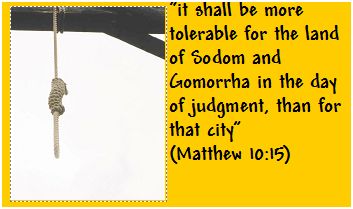
Similarly, He said concerning those who would reject the gospel preaching of His disciples that “it shall be more tolerable for the land of Sodom and Gomorrha in the day of judgment, than for that city” (Matthew 10:15). The wicked populace of Sodom, “giving themselves over to fornication, and going after strange flesh,” will suffer “the vengeance of eternal fire” (Jude 7), but even greater punishment awaits those who willfully reject God’s love in Christ.

There will, indeed, be degrees of punishment in hell, but they will be determined largely in proportion to degrees of “light” rejected. This is an unwanted–but urgently needed–message in these last days!

By Henry Morris (Institute of Creation Research)


If Baptism Is Not a Condition of Salvation, Will You Answer These Questions?

Then Peter said unto them, Repent, and be baptized every one of you in the name of Jesus Christ for the remission of sins, and ye shall receive the gift of the Holy Ghost (Acts 2:38).

1.If baptism is not a condition of salvation, why did Peter mention baptism since he was answering the question of what to do to be saved? (2:37).

2. If baptism comes after salvation, would not repentance also follow salvation, since they are joined by the conjunction and?

3. Is not repentance and baptism in this verse both for the same purpose?

4. If salvation comes before baptism, why does Peter say it is “for the remission of sins”?

5. If the phrase, “for the remission of sins” in Acts 2:38 means because of remission, would not the same phrase in Matthew 26:28 mean because of remission of sins?

6. Did Jesus shed His blood because men were already saved?

7. If Christ did not shed His blood because men were already saved, would it not follow that men are not baptized because they were already saved? The phrase in Matthew 26:28 and Acts 2:38 are identical in both the Greek and English.

8. Would it not be a false doctrine to teach that Christ shed His blood because men were already saved?

9. Likewise, is it not a false doctrine to teach that men are baptized, because they are already saved?

10. If the people on Pentecost were saved before they were baptized, why were they not added to the church until they were baptized, since such as should be saved were added to the church? (2:47).

11. The word church means “the called out” and only those baptized were added to the church. If one is saved before he is baptized, would he be saved before he is called out of the world?

12. Is salvation in the world or in Christ? (2 Tim. 2:10). “Then they that gladly received his word were baptized: and the same day there were added unto them about three thousand souls” (Acts 2:41). “He that rejecteth me, and receiveth not my words, hath one that judgeth him: the word that I have spoken, the same shall judge him in the last day” (John 12:48). “Then cometh the devil, and taketh away the word out of their hearts, lest they should believe and be saved” (Luke 8:12).

1. Can one be saved and not receive the Word?

2. All who received the Word on Pentecost were baptized.

3. Were there any on Pentecost who were saved that did not receive the Word?

4. Does the Word say baptized for the remission of sins or baptized because of remission of sins?

5. How is it possible for one to be baptized as the Word teaches, and not be baptized for the remission of sins?

6. If you were not baptized for the remission of sins, you were not baptized as the Word teaches and therefore were not saved.

7. If not, why not?

Franklin Camp, Deceased


Post Navigation