Antipodean59's Blog

Restored New Testament Christianity

Archive for the tag “church”

Godhead United In Word and Deed

In this week’s thought for the week let’s consider the unity of The Father, Jesus Christ and the Holy Spirit who make the Divine Godhead of the Bible.

The idea that each of the Godhead is divorced of the thought and actions of the other is strange to say the least. For instance, some say that Jesus is love but God the Father is wrath. So, they suggest through implication that God the Father is not love, hmm!
This nonsense has grown, in my opinion, from the thought that people only want love and not the consequence of sin which is wrath.

To show that all three of the Godhead are united in all they think and do, let us consider three separate verses dealing with the topic of sanctification.

• Jude 1 “Sanctified by God the Father.” The Father sets the Christian apart.
• I Corinthians 1:2 “Sanctified in Christ.” Jesus sets the Christian apart.
• I Peter 1:2 “Through sanctification of the Spirit.” The Holy Spirit sets the Christian apart.

Each of the Godhead is in total harmony regarding the sanctification of Christians which is just as true with all the other workings of the Godhead, for Jesus acts just as wrathfully (Revelation 6:16) as God the Father (John 3:36) as much as the Holy Spirit is just as grieved at sin ( Ephesians 4:30) as Jesus is grieved (Mark 3:5).

Jesus said in His prayer to God the Father “that they (the holy apostles GJW) all may be one, as You, Father, are in Me, and I in You; that they also may be one in Us, that the world may believe that You sent Me” (John 17:21). The purpose of Jesus’ words is to show He is united in thought and deed in order to create faith in unbelievers, for the opposite creates disorder and confusion which leads to faulty ideas such as this thought opened with.

God bless as you travel and study through His word.
Graham.

Thought For The Week

I thought I would add a new segment for to end the week with, called “Thought For The Week.”

LAW OF MOSES NOT IN EFFECT TODAY.

“For the promise that he would be the heir of the world was not to Abraham or to his seed through the law, but through the righteousness of faith. For if those who are of the law are heirs, faith is made void and the promise made of no effect, because other law brings about wrath; for where there is no law there is no transgression” Rom.4:11-15.

People need to understand that the Law, as handed to Moses in Exodus, cannot logically be in effect today, for if it were it would contradict the passage above. Paul said it was “nailed to the cross” Col.2:14 meaning it is dead and no longer in effect.

May God bless you as you travel and study through His word.
Graham

There is no Biblical defense for the consumption of alcohol

I’m back from the holidays having relaxed and recharged for a new year that hopefully will be better than last year’s disasters.

As it happens, I viewed some interesting blogs and commentaries that issued forth some poignant thoughts especially of a Biblical nature. However, in printing or referring to such articles or thoughts doesn’t mean I endorse the faith of the author for such may go beyond that which is written (I Corinthians 4:6) or may be in fellowship or endorse the fellowship of those that abide not in the doctrine of Christ and therefore share in their evil deeds (II John 7-11).

One such article that caught my eye comes forth from Martin Johnson, a church of Christ minister who served as a missionary in Indonesia. He presents a position on the consumption of alcohol that I, personally, can relate to when I first became a Christian back in 1985.  Here is a snippet:

When I first became a Christian I thought it was okay for Christians to drink alcohol socially or recreationally as long as they didn’t get drunk. I based this decision on the following reasons:

  • In the first century they couldn’t have prevented grape juice from fermenting since they had no refrigeration.
  • Jesus made wine.
  • Paul told Timothy to drink a little wine.

However, after I began to hear others say that Christians couldn’t drink socially I began to study the issue secretly hoping that they were wrong. But, I’m now convinced that my reasoning was wrong and that Christians have no business drinking alcoholic beverages socially or recreationally.

Read the article and let your heart react to some good, practical advice.

Graham

The truth; i.e., God’s word will set you free from sin


A preacher back in 1958 had the following to say about the truth of God’s word that changeth not over the years in much the same manner as God Who declares: “Every good thing bestowed and every perfect gift is from above, coming down from the Father of lights, with whom there is no variation, or shifting shadow. [This in order that] In the exercise of His will He brought us [that is those who have obeyed his word] forth by the word of truth, so that we might be, as it were, the first fruits among His creatures” (James 1:17-18).

Let us sit back and hear what Melvin Vaughan had to say all those years ago.
Of all those things which are important and essential to man’s spiritual welfare, there is no single item that can affect him more significantly than his attitude toward the truth.
The truth, in a special sense, was made known by the coming of the Lord: “For the law was given by Moses, but grace and truth came by Jesus Christ (John 1:17). It is not surprising that the Lord had so much to say about the truth and what it can do for men. The Lord pointed out that the truth leads men to the freedom most needed: “Then said Jesus to those Jews which believed on him, if ye continue in my word, then are ye my disciples indeed; and ye shall know the truth, and the truth shall make you free” (John 8: 31,32). The truth revealed and applied is the means by which God “sanctified” or sets man aside in His service as the Lord indicated in His prayer: “Sanctify them through thy truth, thy word is truth”3 (John 17:17). So important is the truth to men that the major function of the Comforter or Holy Spirit was to remind the disciples of the truth Jesus had taught them during his ministry (John 14: 26), and to guide the apostles “. . . into all truth” (John 16:13).

The Truth Shall Make You Free

( Melvin L. Vaughan – 1958)

Those to whom the Holy Spirit was sent emphasised the importance of truth. James writes of the “word of truth” as the means by which his readers had been “begotten of God” (James 1:18). Paul reminded the Ephesians that the salvation they enjoyed was the end result of their response to the truth delivered to them (Eph.1:13). Peter points to the truth as the means by which man becomes justified before God: “Seeing ye have purified your souls in obeying the truth through the Spirit unto the unfeigned love of the brethren see that ye love one another with a pure heart fervently: being born again not of corruptible seed, but of incorruptible, by the word of God, which liveth and abideth forever” (1 Pet. 22, 23).

Even though the importance of the truth has been emphasized and its source clearly identified with the will of God; it has been denied, ignored, ridiculed, and misrepresented by men. Those who have sought to uphold the truth have been persecuted, oppressed and even put to death because of their devotion to the truth which they held to be unalterable.
The word of God renders to man an invaluable service by pointing out to him the truth with regard to his state, the limitations of his ability, his great need, and the solution to that need. Paul in examining the spiritual state of the people apart from Christ concluded that “all have sinned and come short of the glory of God” (Rom. 3:23). Sin is identified in the Bible as including both the “transgression” of God’s law (1 John 3:4), and the failure or refusal to fulfil a known duty to God: “To him that knoweth to do good and doeth it not, to him it is sin” (James 4:17).

To recognise the fact of sin and its existence, even in one’s self, is of little significance until it is known that sin is the barrier that separates man from God. “Behold,” the prophet has written, “The Lord’s hand is not shortened that it cannot save, neither his ear heavy that he cannot hear; but your iniquities have separated between you and your God and your sins have hid his face from you that he will not hear” (Isa. 59:1,2).
Here is the truth about man’s state and need. He becomes guilty of sin because he has violated Divine law. Because he is guilty of sin he is alienated from God and should he die in this condition he is forever and eternally excluded from the joys of heaven. A disagreeable picture, to be sure. and unfortunate indeed is the person whose knowledge of the truth goes no further than this!

Man does not have within himself the means or knowledge by which he can free himself from these sins and become reconciled to God. Jeremiah had long since reminded Israel of this: “The way of man is not in himself, it is not in man that walketh to direct his own steps” (Jer.10: 29). To provide the means, God sent His Son to be the propitiation for the sins of the world; to provide the guidance, the Son brought the truth. In the Son is revealed the truth by which alone it is possible to have access to God: “I am the way, the truth, and the life: no man cometh unto the Father but by me” (John 14:6).

Jesus had said: “. . . if ye continue in my word . . . ye shall know the truth and the truth shall make you free” (John 8:32). The truth does provide freedom from ignorance by making both knowledge and understanding available: “The entrance of thy word giveth light, it giveth understanding to the simple” (Psalm 119:130). The truth provides freedom from uncertainty by making the pathway visible: “Thy word is a lamp unto my feet, and a light unto my pathway.” (Psalm 119:105.) The truth makes known the possibility of attaining freedom from sin by showing how the barrier between man and God can be removed: “. . . if ye continue in my word . . . ye shall know the truth and the truth shall make you free” (John 8:31,32). The truth provides this freedom from sin in reality as man obeys the truth: “Seeing ye have purified your souls in obedience to the truth . . .” (1 Pet. 1:22, 23).

The good news of freedom from sin through the sacrifice of Christ and obedience to the truth is called “the gospel” (1 Cor.15:1-4).

For the truth to become to you what it can, and what the Lord desires it to become, it must be sought in the words of the Lord and His apostles (John 8: 31,32). This truth must be approached reverently, respectfully, and open-mindedly that it might produce faith. (Rom. 10: 17; 2 Thess.2:10-12). The response of which a believer involves the turning from sin and error to truth and righteousness inspired by gratitude for His mercy and the desire to please him (Rom.2: 4). The removal of the guilt resulting from sin is to be found where the Lord placed it in His death where His blood was shed. According to the truth the penitent believer is “baptized into his death” (Rom.6:3,4), “for the remission of sins” (Acts 2:38). It is here that he is made “free from sin” (Rom.6:18), has his sins “washed away” (Acts 22:16), enters Christ (Gal.3:27), and becomes a “new creature” (2 Cor.5:17).
The church, which is composed of the saved (Acts 2:47), is to be the “pillar and ground of the truth” (1 Tim.3:15). The ‘disciple indeed” is to “let his light so shine before men that others may see his good works and glorify his Father which is in heaven” (Matt. 5:13-16). The teacher must uphold the truth at all times in its purity and fullness as revealed by the Lord (2 Tim.2: 2; Jude 3).

Love and devotion to the truth leads the new creature to walk in the steps of him who “. . . left us an example. . . .” That he might “draw near with full assurance of faith having his heart sprinkled from an evil conscience and his body washed with pure water” (Heb.10:22).
“Then said Jesus to those Jews which believed in Him: If ye continue in my word then are ye my disciples indeed and ye shall know the truth, and the truth shall make you free” (John 8: 31,32).

  • Will you recognise according to God’s standard that you are caught up in sin and need to rectify it?
  • Will you follow the steps provided by the unchangeable word that leads to freedom from sin?
  • Will you enter the church that is Christ’s body where the truth that sets you free is a “pillar and ground”?
  • If you are willing to follow, let it be known to Christ’s church that gathers in your neighborhood or reply to this post and let “us reason together” (Isaiah 1:18).

The onus is on you to prove it

The apostle Paul said to make sure that one “Prove all things” (I Thessalonians 5:21). Just because something is widely accepted as being true and is therefore the supposed starting point i.e., an axiom, doesn’t prove anything. If it is true then you are under obligation to “prove” it.

The apostle Peter told the 1st Century church to do as much regarding their faith. He said they were obligated to give a “reason” for their “hope” (I Peter 3:15).  For instance the axiom “God is love” needs to be proven with valid reasoning if it is to be convincing. After all faith in such, according to Paul, can only come about by hearing God’s word (Romans 1:17; 10:17) which implies a reasoning mind.

The axiom that is widely accepted as being true is that of organic evolution. That is life somehow started from a single cell and grew to the complexity of life we see before us today.  If that be true then the adherent must prove it to be so.

Here is an excellent article that might help to explain why I say such and help you as well (that is, of course, if you have the willingness of mind to indulge:)

Graham

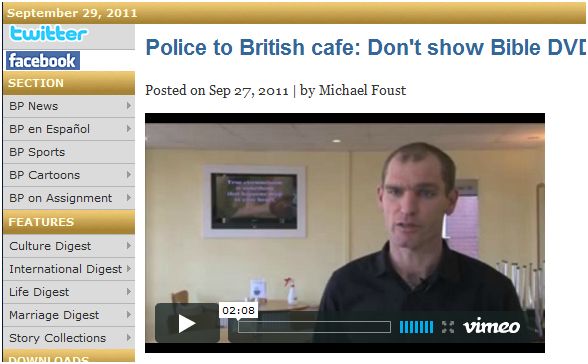
So much for religious freedom in the UK

The following information you might find unsurprising if the story emanated from, say, Saudi Arabia, Iran or Afghanistan but no this comes from the UK.

Police invoke public disorder act to shut down Bible verses 

How to answer the hackneyed objections to a young Earth

The following link gives ammunition to those who want answers to the hackneyed objections raised by the evolution fanatics.
Geology and the young Earth article will be of assistance to genuinely wanting well constructed answers.

Graham

Importance of Pentecost

The day of Pentecost as referenced in Acts 2 was a result of fifty days from the Passover Sabbath (πεντηκοστή pentēkostē fiftieth from Passover, Strong’s Dict.). This day was counted from “the morrow of the Sabbath” (Lev.23:15) when the omer of barley harvest i.e. “wave sheaf” was first cut.  The count of these weeks was to start the day the sickle cut that first wave offering (Dt.16:9). This barley harvest was to be over and done within 7 weeks i.e. 49 days from which the “Feast of Ingathering” (Ex.23:16) or “Day of First Fruits” (Num.28:26) as they were known under the Old Testament could begin. This day of Pentecost marked the beginning of the wheat harvest, hence the term “first fruits”.  It is no coincidence, in my humble opinion, that the two different corns represent the Old (i.e., barley) and the New Testaments (i.e., wheat) [any crop farmer will attest barley always precedes wheat in harvest times].


A simple count of 49 days beginning “the morrow of the Sabbath” will, without exception, bring one to the first day of the week that we call Sunday.  This day marked the beginning of the church, of which there is, without exception, only one (Eph.4:4).


It goes without saying this church needed entry conditions explained i.e. the plan of salvation given by Peter upon request of those who crucified Jesus (Acts 2:37—41).  In addition, this church was instructed via the “apostle’s doctrine” regarding fellowship and worship (Acts 2:42-47). It is important to note that the “breaking of bread” in verse 42 differs from “breaking bread from house to house” found in verse 46. The former concerns the immediate context with the Lord’s Supper memorial for “the breaking” is tn klasis i.e. the fracture, the specific act of breaking the specific bread [the Greek places the definite article tn before breaking and tov before bread indicating specificity] that Adam Clarke points out: “Breaking of bread was that act which preceded a feast or meal, and which was performed by the master of the house, when he pronounced the blessing – what we would call grace before meat”. The word is employed by Matthew in chapter 26:26 where Jesus, the Master, “took the bread, blessed it and broke [klasis] it” because it represented His body upon the soon to be realised cross, a solemn and shameful (Gal.3:13) event.  This in contrast with the latter “break” is klaō i.e. to generically break which the immediate context of the remainder of the verse says “they ate their food with gladness and simplicity of heart”. They were simply breaking the food apart to eat it with gladness of fellowship together with people of common salvation.


This having been said indicates the absolute importance of the first day of the week for the church to assemble for authorised worship and fellowship.

Graham

Are We Added or Do We Join?

Many people are confused about the question of whether or not one joins the church which the Christ built or is added to it. Some rather casually say that they have decided to join the church of Christ. However, is that statement one that can be made accurately in light of what the Bible says about this subject? To find the answers, consultation of the Scriptures will be necessary. Acts chapter two describes the inception of the church. At the end of the chapter, Luke records this, “Praising God, and having favour with all the people. And the Lord added to the church daily such as should be saved” (Acts 2:47). An examination of this verse in the Greek text reveals that “the Lord” is the subject of this sentence. As the subject of this sentence, the Lord is doing the action, which is the Greek word translated “added.” Hence, God is performing the action of adding. Webster’s dictionary from 1828 gives these definitions for “add”: “…1. To set or put together, join or unite, as one thing or sum to another, in an aggregate; as, add three to four, the sum is seven. 2. To unite in idea or consideration; to subjoin… 3. To increase number… 4. To augment…” (E-sword, 2007). Those who were “added” were united or brought into the church by God. The next point that should be understood is the object of the “adding.” The Greek participle and its article “tous (article) sozomenous (participle)” is translated “such as should be saved” which we would understand as “the being saved ones.” This Greek word and its article are in the accusative case meaning that it is the direct object of the verb. “The being saved ones” were being added.

Who then are these saved ones? Our Lord clarified this in Mark chapter sixteen, “And he said unto them, Go ye into all the world, and preach the gospel to every creature. He that believeth and is baptized shall be saved; but he that believeth not shall be damned” (Mark 16:15-16). Jesus plainly stated that the saved are comprised of those that believe and obey the Gospel. Now please consider Acts 2:38-41. Those that were baptized (remember Mark 16:16) were those that had hearkened unto Peter’s sermon. Peter preached the Gospel, (again, please remember Mark 16:16) they believed, and were baptized; thus, becoming part of the saved. And it is the saved that were “added” by the Lord. There is an indirect object in this sentence, as well. The Greek noun and its article “ta (article) ekklasia (noun)” are in the dative case meaning that they are indirect objects. “The church” is the body into which the saved were added. The verb “added” was done to the saved and the saved were placed into the church. All of this was done by God.

The above explanations are somewhat in depth, though certainly not exhaustive. The verse which has been examined is a very simple and straight forward pronouncement of the process in question. Daniel chapter two supports the fact that the Lord adds one to the church, not man.

“And in the days of these kings shall the God of heaven set up a kingdom, which shall never be destroyed: and the kingdom shall not be left to other people, but it shall break in pieces and consume all these kingdoms, and it shall stand for ever. Forasmuch as thou sawest that the stone was cut out of the mountain without hands, and that it brake in pieces the iron, the brass, the
clay, the silver, and the gold; the great God hath made known to the king what shall come to pass hereafter: and the dream is certain, and the interpretation thereof sure” (Dan. 2:44-45). This kingdom (which is the church) would not be established or founded by men.

Our Lord said that He would build (establish) His church (Matt: 16:18). The adding of souls to that church was certainly a part of its establishment. Jesus said He would build His church. He is saying by implication that He would be adding to His body. The Lord is head over the church (Col. 1:18); and as Head, He determines the way into His body.

Our Lord rules over His kingdom (Col. 1:13, 18). Headship of the church, salvation, forgiveness, reconciliation, and the giving of commandments to be obeyed belongs to the Christ. The church was prepared, established, and is kept by God and not by man. The church is not a man-made nor human ruled body, to which we may join ourselves at our own discretion and upon our own terms. Acts 2:47 states the matter very plainly: the Lord adds us to church upon our obedience to the Gospel.

John Rose
Naples, Florida

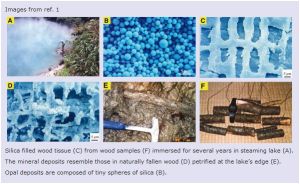
Wood to rock in no time

Many evolutionists would have you believe that organic matter is petrified only after long periods of time have elapsed.  Assuming you have an open mind then perhaps you might consider the article found here.

Post Navigation